
Mariana S. Țăranu
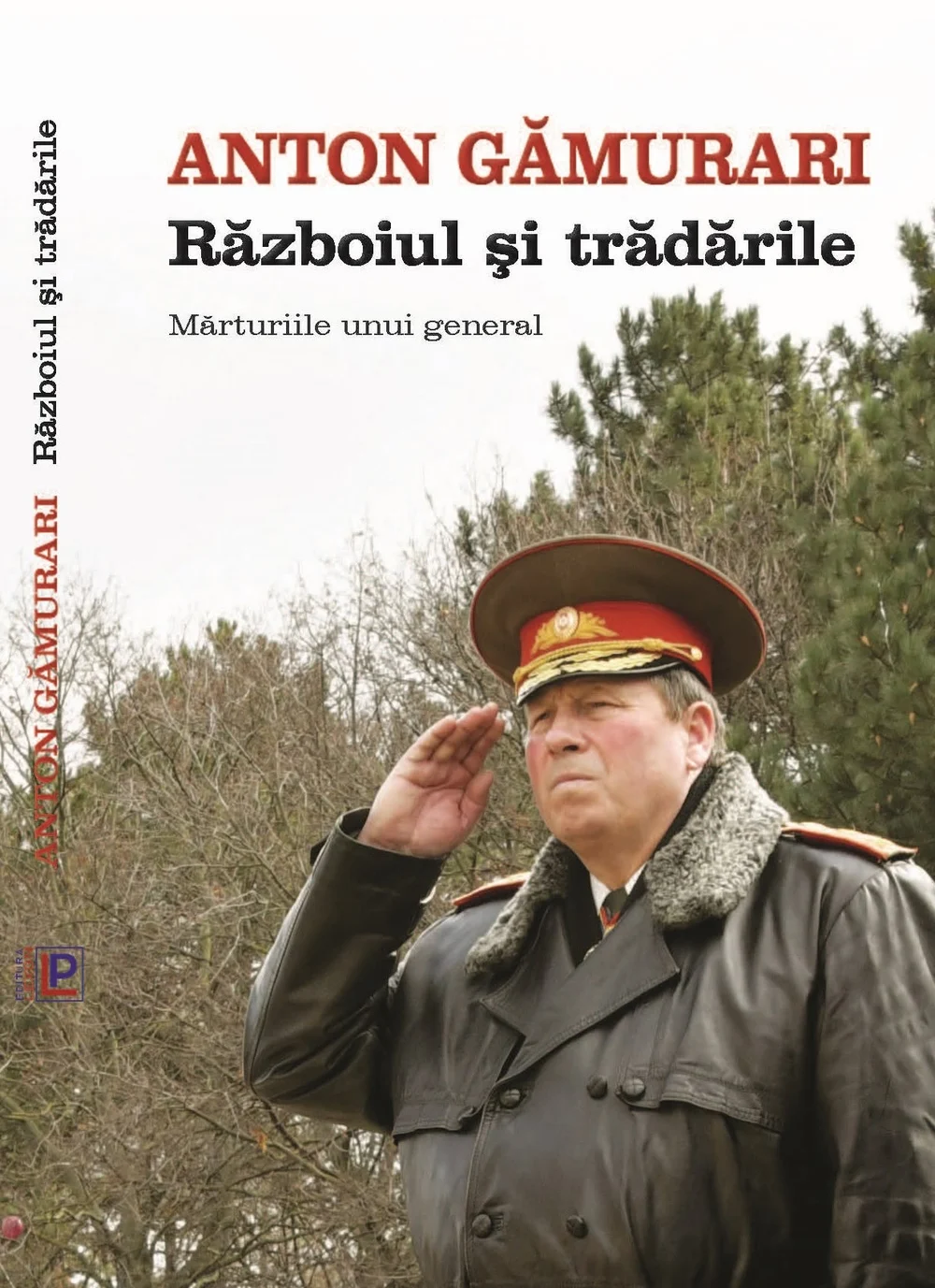
“I served my country, not particular people who would pay me for doing so...” These words by General Anton Gămurari open Războiul și trădările. Mărturiile unui general (“War and Betrayals: A General’s Testimony”). For me, they express the question running through the entire book: what happens to those defending a state when its leaders’ decisions fail to give them the support they need? [1, p. 2]
I met Anton Gămurari on 16 June 2017 during Recurs la istorie, my programme on “Vocea Basarabiei” radio. Our conversation continued after the broadcast. I proposed that he tell his story in a book. Between June and October, we recorded ten hours and twenty minutes of interviews, which I transcribed, edited and organised. I preserved the general’s voice and complemented his recollections with the radio interviews, his February 2017 speech and a study of the historical context. [1, pp. 10–12; 225–260]
My purpose went beyond recovering a commander’s biography. I wanted to understand how the Republic of Moldova’s independence was defended, and why the experience of those on the front differs so markedly from the formulas subsequently used to explain the war.
Declaring independence and defending a state
In 1992, the Republic of Moldova was a recently established state. Its declaration of independence did not automatically provide control over its territory, consolidated institutions or a defence system capable of responding to a confrontation of this scale. Gămurari’s testimony exposes the distance between a state’s legal existence and its capacity to protect its citizens.
The general came from the Ministry of Internal Affairs and had commanded special police units. Examining his contribution therefore also means tracing the police’s role in defending constitutional order while the new state’s military structures were still taking shape. [1, pp. 7–8; 81–96]
In his introductory contribution, historian Ruslan Șevcenco emphasises Gămurari’s ability to organise resistance and his loyalty to his country. I share that assessment, but take the question further: why were a commander’s efforts and his subordinates’ courage not matched by institutional coordination? Recognition of individual achievements should open an examination of how the state functioned. [1, pp. 7–9]
A war fought among people’s homes
Gămurari stresses the distinctive setting of the fighting: villages and towns, the vicinity of homes, and terrain familiar from everyday life. The Dniester was simultaneously an obstacle, a crossing route and a connection between those fighting and those who could help them.
In his account of the sector between Gura Bâcului and Răscăieți, he describes using small groups and adapting continually to the terrain. He explains why military schemes devised for large operations could not simply be applied: he lacked comparable manpower and resources, while the fighting took place in inhabited settlements. [1, p. 96]
For me, this passage matters because it brings war back to the level of a concrete decision. The commander had to decide where to send people, what support they would receive and whether a mission could be completed without unnecessary losses. An operational map also represented homes, families and roads leading back to them.
This perspective does not replace operational documents. It asks questions that overall assessments can obscure: who possessed the information, who took responsibility for the decision, and who bore the consequences?
What “betrayal” means in wartime testimony
I chose the title Războiul și trădările because this word returned repeatedly in our conversations. Gămurari used it to describe what he saw as the abandonment of men, the disclosure of information or decisions that undermined defence. [1, p. 11]
One episode concerns an operational plan presented to the military leadership. According to his account, after explaining the plan he observed the enemy reinforcing positions in the areas it targeted. He interpreted the sequence as evidence of an information leak and refused to commit his men under the changed conditions. [1, pp. 97–98]
The source allows us to reconstruct what the commander reported and how he explained the cancellation of the operation. Alone, it cannot identify who might have passed on the information or establish the intentions of every participant in the meeting. Such questions require orders, reports, correspondence and the comparison of testimonies.
My position is clear: the allegation must be investigated, and the witness’s indignation understood. In research, “betrayal” must be broken down into verifiable actions. A mistake, a political decision, failed coordination and the deliberate transmission of a secret are different acts, even when they can have equally serious consequences on the front.
Memory also preserves the meaning of experience
Alessandro Portelli shows that oral sources preserve the meaning of experience, while factual verification remains necessary. [2] This helps explain why I return to how Gămurari constructed his account: which episodes he repeated, where he recalled a subordinate’s name, and when he returned to unanswered questions.
Twenty-five years separated the war from the recordings made in 2017. During that period, his experience of the fighting had become intertwined with postwar disappointments. The general spoke both as a participant and as someone retrospectively judging the relationship between sacrifice and recognition.
I therefore distinguish direct experience, information received from others and subsequent interpretation. This reading makes the testimony more precise and enables dialogue with other historians. Respect for a witness also entails explaining the limits of what their voice can establish.
Russia’s responsibility does not disappear behind terminology
In the book’s Argument, I explicitly maintained that the events of 1992 must be understood as a war waged by the Russian Federation against the Republic of Moldova. “Armed conflict” describes the existence of fighting, but does not by itself explain who supported separatism militarily or how the balance of forces emerged. [1, pp. 10–11]
In its judgment in Ilaşcu and Others v. Moldova and Russia, delivered on 8 July 2004, the European Court of Human Rights established that forces of the 14th Army fought alongside the separatists and that weapons were transferred to them. [3, § 380]
This independent finding supports an examination of Russian military involvement. It does not automatically confirm every individual allegation made by the general. It does, however, prevent the external military factor from being treated as mere background to a local confrontation.
For me, the responsibility of decision-makers in Chișinău and Russia’s involvement must be examined together. Institutional weaknesses explain the attacked state’s vulnerability; they do not erase the responsibility of the power that supported separatism militarily.
The ceasefire and the question of “peacekeepers”
In the contextual study included in the volume, I examine the Moldovan–Russian agreement of 21 July 1992 and the security mechanism established after the ceasefire. Russia’s participation raises a central question: how did a power involved in supporting the separatists militarily come to participate in administering peace? [1, pp. 258–259]
This problem also appears in the general’s questions about the duration of the “peacekeeper” role. [1, p. 252] A ceasefire was necessary to stop the loss of life. But stopping the fighting and restoring effective sovereignty are two different outcomes.
My interpretation follows that distinction: an arrangement that reduces violence can simultaneously preserve a balance of power created through military intervention. Historians must examine both effects, including from the perspective of citizens who expected protection from their state.
A duty to those who defended the country
Gămurari recalled that former combatants continued to turn to him for help and still regarded him as their commander. [1, p. 219] For me, this is one of the book’s most important continuities: responsibility towards people did not end when they left the front.
The volume is a source for understanding the war, institutional fragility and the memory of those who lived through it. It preserves questions that can become research topics and returns names and experiences to a history often reduced to negotiations and diplomatic formulas.
This is also why it belongs on my blog: to explain mechanisms of domination and their consequences through sources and human experience. Research on the Soviet period and testimony about 1992 meet in questions of power, vulnerability and the defence of dignity, while the differences between the periods remain essential.
“I served my country” is a personal credo. Read through to the end, it also becomes a question addressed to institutions: how did the state fulfil its duty to those who defended it?
References
[1] Anton Gămurari, Războiul și trădările. Mărturiile unui general, mărturii transcrise și editate de Mariana S. Țăranu, Chișinău, Lexon-Prim, 2025. Trimiterile urmează paginația ediției finale: p. 2, crezul generalului; pp. 7–9, Ruslan Șevcenco, „Anton Gamurari: forța rezistenței pentru integrarea Moldovei”; pp. 10–12, „Argument” și „Cuvânt înainte” de Mariana S. Țăranu; pp. 81–96, rolul poliției și condițiile luptelor; p. 96, adaptarea operațiunilor la teren; pp. 97–98, planul de operațiune și presupusa scurgere de informații; p. 219, sprijinul solicitat de foștii combatanți; p. 252, întrebările generalului; pp. 258–259, analiza acordului din 21 iulie 1992 în „Post scriptum”. Data și editura: programul oficial Bookfest Chișinău 2025, https://bookfest.ro/bookfest-chisinau-2025-events.
[2] Alessandro Portelli, „What Makes Oral History Different”, text republicat din The Death of Luigi Trastulli and Other Stories: Form and Meaning in Oral History, State University of New York Press, 1991. Pentru verificarea factuală și specificul surselor orale: secțiunea „Should we believe oral sources?”. Reproducere integrală consultabilă: https://www.academia.edu/59004168/What_Makes_Oral_History_Different. Versiune PDF în platforma universitară DUTH: https://eclass.duth.gr/modules/document/file.php/KOM03271/%CE%A0%CF%81%CE%BF%CF%86%CE%BF%CF%81%CE%B9%CE%BA%CE%AE%20%CE%99%CF%83%CF%84%CE%BF%CF%81%CE%AF%CE%B1%203.%20portelli-what-makes-oral-history-different.pdf.
[3] Curtea Europeană a Drepturilor Omului, Marea Cameră, Ilaşcu and Others v. Moldova and Russia, cererea nr. 48787/99, hotărârea din 8 iulie 2004, § 380. Text oficial: https://hudoc.echr.coe.int/eng?i=001-61886.