Institutions change, official language is replaced, and political borders may be redrawn. Yet fears, reflexes, networks of influence, and attitudes towards power often endure far longer.
For this reason, I study communism not only as a historical period, but also as an experience whose effects continue to shape the contemporary world.
Power, Society and Control
One of the main areas of my work is the study of how the Soviet state functioned.
I am interested in the ways in which political power intervened in people’s lives, reshaped institutions, controlled information, and transformed fear into an instrument of governance.
Archival documents reveal not only the decisions taken by the state, but also how people responded: through adaptation, silence, compromise, resistance, or simply the effort to survive.
The Intelligentsia under Soviet Rule
A distinct area of my research concerns Soviet state policy towards the intelligentsia.
Members of the intellectual community were monitored, subjected to ideological control, marginalised, or turned into instruments of the regime’s official legitimisation. Some collaborated with the authorities, others attempted to preserve spaces of intellectual autonomy, while others paid a high price for refusing to conform.
I am particularly interested in this area of tension between creativity and obedience, truth and censorship, intellectual responsibility and state pressure.
The Famine of 1946–1947
The famine of 1946–1947 is one of the central themes of my research.
I examine it not only as a demographic catastrophe, but also as the result of political, economic, and administrative decisions that transformed food shortages into a large-scale social tragedy.
Behind the statistics were broken families, orphaned children, weakened communities, and desperate strategies of survival.
I am also interested in the ways in which this tragedy was concealed, minimised, or removed from public memory.
Deportations and Political Repression
Soviet deportations and political repression demonstrate how a state could transform ordinary people into “enemies” through a single administrative label.
I study the mechanisms through which victims were selected, the language used to justify repression, and the consequences of these policies for families and communities.
An archival document may contain only a few lines, yet behind those lines there may be an entire life destroyed.
The Russian Federation’s War against the Republic of Moldova in 1992
The war waged by the Russian Federation against the Republic of Moldova in 1992 occupies an important place in my research.
I examine the causes of the conflict, the political and military involvement of the Russian Federation, the experiences of combatants and civilians, the territorial and political consequences, and the ways in which the memory of the war has been constructed since 1992.
This war does not belong solely to the past. Its consequences continue to shape the security of the Republic of Moldova, its domestic politics, and relations between Chișinău, Tiraspol, and Moscow.
Propaganda, Memory and Influence
Propaganda does not operate only through direct falsehoods. It selects convenient facts, exploits fears, and offers simple explanations for complex problems.
I study how Soviet propaganda constructed the image of the enemy and controlled public perception, as well as how these techniques continue to be used in the post-Soviet space.
I pay particular attention to the ways in which the Russian Federation uses the memory of communism, identity, religion, nostalgia, and the fear of war to influence public opinion and political decision-making.
Eastern Europe after Communism
A significant part of my research is devoted to the relationship between the communist past and contemporary political crises.
I seek to understand:
- why European integration does not automatically generate trust;
- why societies that experienced dictatorship may once again become receptive to authoritarian leaders;
- how the memory of lost sovereignty can be used against democratic institutions;
- why nostalgia, fear, and the need for dignity become political resources;
- why the influence of the Russian Federation persists in some societies that emerged from communism.
The Russian Federation’s War against Ukraine
The war against Ukraine has brought back to Europe realities that many believed belonged to the past: occupation, deportation, destruction, propaganda, and the denial of a state’s right to exist.
I examine the consequences of the war for the security of Eastern Europe, the Republic of Moldova, and Romania, as well as for relations between individuals and communities.
I am particularly interested in the ways in which the war is transforming relations between Russians and Ukrainians, shared memory, identity, and perceptions of Russia.
Research Sources
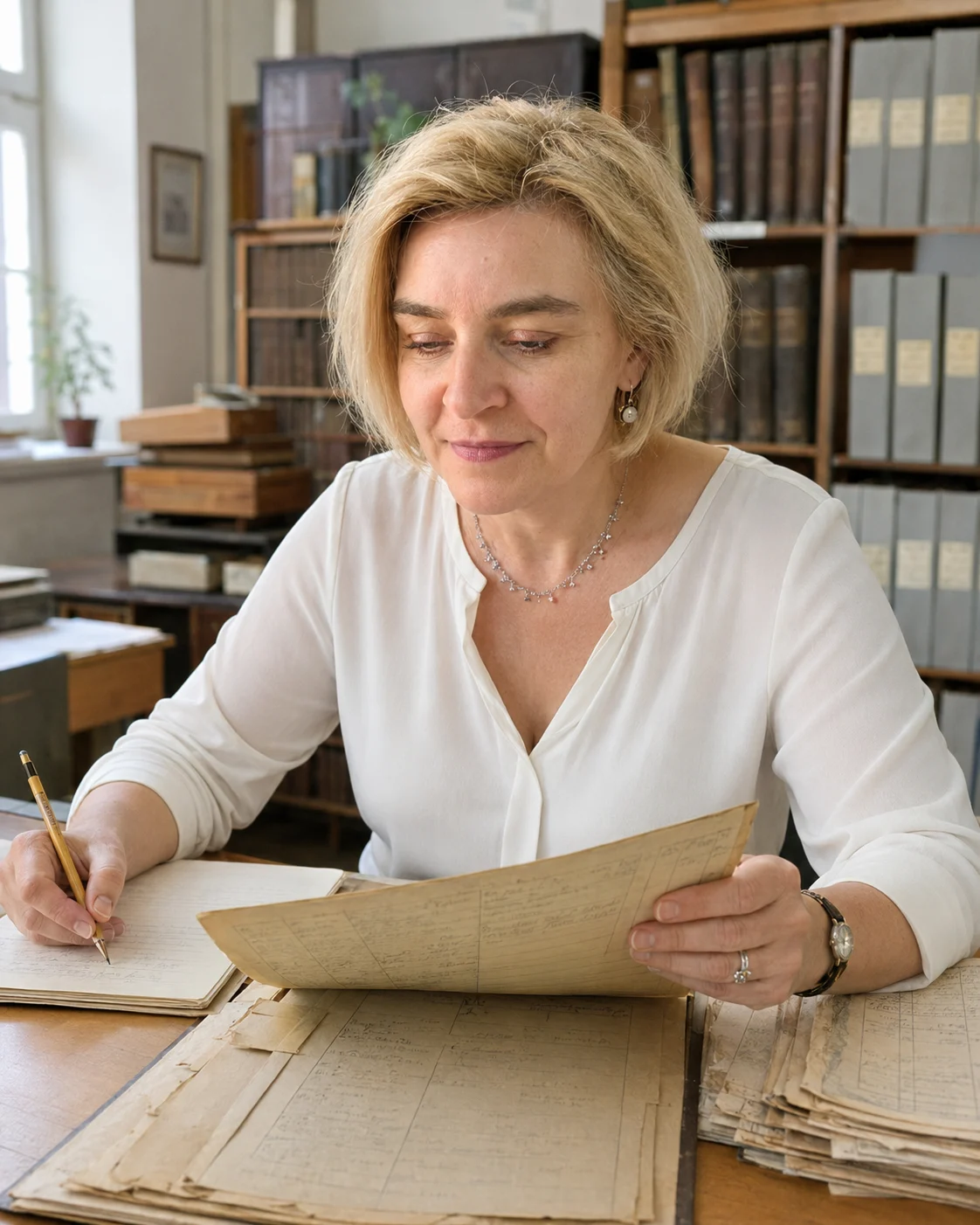
My research is based primarily on archival documents, but also on testimonies, interviews, the press, official sources, statistical data, opinion surveys, and academic literature.
The document remains my starting point. It makes it possible to verify claims, reconstruct the mechanisms of power, and recover the voices of those whom authoritarian regimes attempted to silence.
For me, historical research is not only about establishing facts. It is also about understanding how the past continues to shape the choices, fears, and conflicts of the present.