
Mariana S. Țăranu, historian, PhD in History
What does Bessarabia’s history look like when we follow it through the life of a single community? What does land reform mean for a family, a change in the language of instruction for a child, or the establishment of a new political regime for villagers?
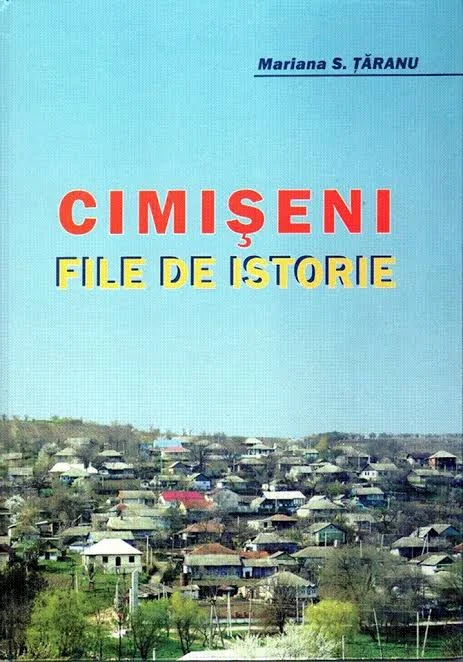
In Cimișeni – file de istorie (1660–2013) — Cimișeni — Pages of History (1660–2013) — I explored these questions through the history of my home village. I examined landownership and population, local government, education, religious life, the economy and healthcare, alongside wars, repression, deportation and famine. My concern was how political changes entered households and reshaped people’s lives.
Land and people: the starting point of a history
The documentary reference dated 15 July 1660, discussed in the book, concerns the land on which the village subsequently developed. The information comes from Radu Rosetti’s research on landownership in Moldavia. Earlier forms of the village’s name — Ciumeșeni, Ciumeșani and Ciumișeni — help us trace it through records from different periods (pp. 6–7).
I consider it necessary to distinguish between the earliest documentary reference identified and the foundation of a settlement. A document provides a reliable starting point for research; the community itself may have older origins.
Land occupies an important place in the book because families’ livelihoods and independence depended on it. Following the land reform introduced after 1918, records identify 238 residents recognised as entitled to receive land. Six hectares were reserved for the school (p. 8). These details show how a national reform took concrete shape within a village.
Education: development through individual lives
The school’s history reveals the opportunities and limitations of successive periods.
In 1890, thirty-five children enrolled in Cimișeni’s first one-year church school: twenty-six boys and nine girls. According to the records examined, only one pupil, Profire Dicusar, passed the end-of-year examinations. Teaching took place in Russian (p. 26).
Beyond these figures, I am interested in the gap between enrolment and completion. Access to education depended on the language of instruction, household resources and the time children could devote to school.
After 1918, the school was reorganised. A new building with two classrooms and a staff room was completed in 1921. During the same period, villagers raised money to establish a library (p. 33). The community was participating in its own development.
A film projector in a church inventory
A striking detail appears in the church property inventory reproduced in the book. Alongside books, icons and liturgical objects, it lists a “Pathé Baby” film projector, recorded as faulty, and several films on religious subjects (pp. 63–65).
These objects show that the village had access to modern forms of visual communication. The inventory does not establish how frequently films were screened, but it documents the presence of equipment and film reels.
In 1933, the foundation stone of a cultural centre was also laid, following an initiative by priest Gheorghe Roșca (p. 62). Such information matters to me because a community’s history includes initiative, education and aspirations for progress.
Famine: administrative records and family memory
In examining the famine of 1946–1947, I compared administrative records with survivors’ accounts.
Cimișeni’s relief kitchen operated between December 1946 and March 1947. A shortage of fuel to heat the premises meant that food was delivered to people’s homes. Records describe daily allocations of 200 grams of bread to 240 people and the need to feed additional residents suffering from illness (pp. 89–90).
Ioana Cucinschi recalled that her family kept its cow inside the house for fear of theft, while her mother exchanged clothing and household possessions for barley. Uliana Țăran described substitute foods and the goat that helped her family survive (p. 91).
Documents describe the distribution of food; testimony brings us closer to the daily effort of staying alive. Regarding the village’s total death toll, I explicitly note in the book that the sources consulted do not allow an exact figure to be established (p. 90).
A book about roots and change
My research drew on records from archives in the Republic of Moldova, contemporary newspapers, scholarly literature and villagers’ testimony. I also acknowledged its limitations: missing documents sometimes prevent a complete reconstruction of the past.
The book has a personal dimension. It is dedicated to my parents, Simion and Lidia Țăranu. My mother was among those who helped organise and supplement the material, alongside other members of the community (pp. 3–5).
Cimișeni — Pages of History is for readers tracing their roots, those interested in local history, and anyone seeking to understand Bessarabia through concrete human experiences. Names, documents and photographs preserve the community’s memory and reveal how people sought to build their lives under changing circumstances.
Book presented: Mariana S. Țăranu, Cimișeni – file de istorie (1660–2013).
References indicate the printed pages of the Romanian text.