
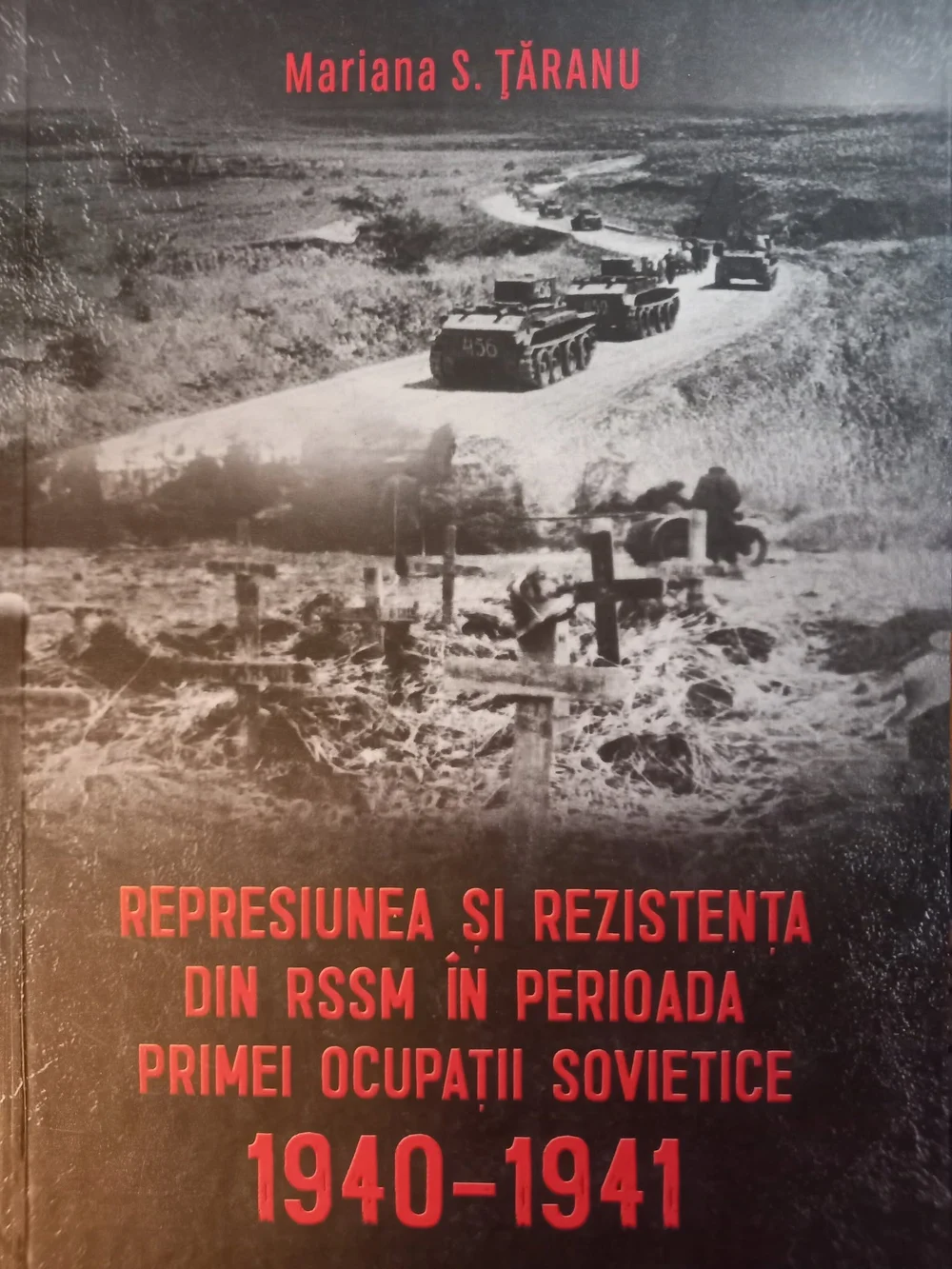
Mariana S. Țăranu
What happens to a society when, within a single year, its authorities, laws, property relations and the rules governing its children’s education are changed? For the inhabitants of Bessarabia, this question became a reality after 28 June 1940. In my book Represiunea și rezistența din RSSM în perioada primei ocupații sovietice (1940–1941) (“Repression and Resistance in the Moldavian SSR during the First Soviet Occupation, 1940–1941”), I explored how military occupation became control over everyday life and how people responded to that transformation. [1, pp. 8–10]
My interest in this year took shape while I was studying at the Ion Creangă State Pedagogical University in Chișinău. I subsequently returned to it over more than two decades. Documents from the National Archives of the Republic of Moldova, the Archive of Social and Political Organisations and the Special Repository of the Intelligence and Security Service, alongside testimonies and the contemporary press, allowed me to examine both the institutions of repression and the experiences of those subjected to them. [1, pp. 6–7; 66–71]
My position is explicit: repression was an instrument for establishing the Soviet order. Studying resistance also means restoring people’s capacity to respond, to refuse and to defend what they considered essential.
Occupation did not end with the army’s arrival
On 28 June 1940, the Soviet Union occupied Bessarabia following its ultimatum to Romania. The Moldavian Soviet Socialist Republic was established on 2 August 1940 from part of Bessarabia and part of the former autonomous republic east of the Dniester. Bessarabia and the Moldavian SSR therefore do not designate the same territory. This distinction is necessary to understand where, and upon whom, the new institutions acted. [1, pp. 8–9]
In my research, “occupation” has concrete content: a change of power through military coercion, the extension of the Soviet repressive apparatus, the confiscation of property and the removal of previous institutions. The Soviet formula of “liberation” must be tested against these processes.
In the book, I discuss Artiom Lazarev’s interpretations, which presented the events of 1940 as the resolution of the “Bessarabian question” and the reunification of the population within a Soviet state. My objection concerns how this explanation turned Moscow’s political project into the presumed will of the inhabitants. To test that presumed will, we must also examine flight, protest, persecution and the actual possibility of refusing the new order. [1, pp. 15–19; 350–353]
How a person’s biography became an accusation
The establishment of the NKVD—the People’s Commissariat for Internal Affairs, which performed political policing functions—and the operation of tribunals, the prosecution service and prisons created the infrastructure of repression. Within this network, a previous occupation, political affiliation or social position could become grounds for suspicion. [1, pp. 350–354]
Elena Postică’s work on members of Sfatul Țării, Bessarabia’s representative assembly, and Gheorghe Palade’s studies of prominent figures from Soroca helped recover the names and lives of those repressed. I discuss them in the monograph and pursue the question of the mechanism: how did the new authorities turn activities carried out under the Romanian administration into grounds for conviction? [1, pp. 49–50]
The testimony of physician Pavel Ciobanu-Răzeșu, analysed in the book, makes the vulnerability of the person under interrogation visible. He recalled signing records without reading them because he did not know Russian, while interrogation took place without an interpreter. This is a survivor’s account and must be identified as such. Nevertheless, it shows why a signature in a case file cannot automatically be equated with a free and informed confession. [1, pp. 99–100]
For me, a repressive case file is also a document about its authors. Before repeating an accusation, the historian must examine who formulated it, under what conditions and for what purpose.
Property and the border: two forms of lost freedom
The confiscation of goods and attempts to establish collective farms changed the relationship between the family and the state. The household became an object of political intervention, while opposition could be described as hostility towards the regime. [1, p. 355]
My dialogue with Igor Cașu, whose documentary collection on identifying the “class enemy”, property confiscations and labour mobilisation I analyse in the volume, concerns precisely the connection between classifying people and using their resources. The contribution I seek is to integrate these mechanisms into local life: how were they experienced, and what responses did they produce? [1, p. 64]
In Budăi, in the Telenești district, the document discussed in my book shows that residents were required in August 1940 to repay their bank loans within twenty-four hours. To pay, householders hurriedly sold their animals for negligible sums. This case reveals economic pressure at the level of a family, beyond the administrative terminology of a reform. [1, p. 245]
The closure of crossings over the Prut and the permit system for crossing the Dniester restricted the possibility of leaving. Attempts to cross the Prut clandestinely could lead to investigation and imprisonment. Control over resources and movement reinforced each other: the authorities intervened in the household and limited departure from the territory they administered. [1, pp. 350; 353]
Resistance also appears in the defence of a village priest
In the book’s introduction, I explained that the resistance examined was predominantly individual and needed to be analysed in the context of the actions that provoked it. The absence of a mass movement does not demonstrate acceptance of occupation. [1, pp. 9–10]
The “Majadahonda” organisation in Orhei provides an example of organised resistance through leaflets and the display of the Romanian tricolour. Yet the picture is broader: refusal, defending possessions, attempts to leave and religious solidarity express different responses. Not every adaptation for survival can be called resistance; intention, action and the risk undertaken must be examined. [1, pp. 354–355]
In Bravicea, the account reproduced in the volume describes villagers intervening so that their priest, summoned for compulsory labour at Easter, could return to the community. The source is the newspaper Basarabia of 19 February 1942: a later account published in a wartime context, requiring comparison with other testimonies and documents. I do not treat it as an official record of the incident. It nevertheless preserves a form of local solidarity that deserves investigation. [1, p. 265, note 1196]
Faith and culture became questions of power
In my analysis of Valeriu Pasat’s documentary collections, I acknowledge the importance of documents on relations between the state, the church and believers, but emphasise communities’ responses. Research into religious policy must follow both the decisions of the leadership and people’s capacity to defend their practices and institutions. [1, pp. 63–64]
The book documents the closure and repurposing of religious buildings, including some synagogues and Baptist prayer houses. These examples show the reach of antireligious policy beyond a single denomination. The reorganisation of schooling and control over the press and books extended intervention into community life. [1, pp. 263–264; 356–358]
Sovietisation must therefore also be investigated through the places where people learned, worshipped and transmitted their memory. Transforming those places changed society’s sources of authority and solidarity.
Why I return to this year on my blog
This book explains the emergence of mechanisms of domination that I also follow in my research on famine and letters to Stalin. The connection between these subjects is power over resources, freedom and dignity, while respecting the differences between periods.
In the note on the edition, I distinguished this research from a separate study devoted to the deportations of June 1941. The present volume helps us understand how society had already been transformed before that moment. [1, p. 6]
The question I am left with is this: how does the relationship between the individual and the state change when defending one’s home, faith or personal history becomes grounds for suspicion? The documents explain the establishment of fear. Studying resistance helps us see what people tried to preserve despite it.
References
[1] Mariana S. Țăranu, Represiunea și rezistența din RSSM în perioada primei ocupații sovietice (1940–1941), Chișinău, Lexon-Prim, 2021, ISBN 978-9975-3300-8-4. Trimiterile urmează paginile numerotate din exemplarul consultat. Referințe principale: pp. 6–7, geneza și delimitarea proiectului; pp. 8–10, obiectivele, spațiul cercetării și rezistența individuală; pp. 15–19, interpretările sovietice discutate de autoare; pp. 49–50, contribuțiile Elenei Postică și ale lui Gheorghe Palade; pp. 63–64, culegerile lui Valeriu Pasat și Igor Cașu; pp. 66–71, presa și memorialistica; pp. 99–100, mărturia medicului Pavel Ciobanu-Răzeșu; p. 245, cazul Budăi; pp. 263–265, politica antireligioasă și cazul Bravicea; pp. 350–358, sinteza rezultatelor cercetării.
Surse și lucrări discutate prin intermediul monografiei:
Elena Postică, „Deputații Sfatului Țării represați în anul 1940”, Cugetul, 1998, nr. 3, pp. 92–98; discutată în [1], p. 49, notele 156–157.
Gheorghe Palade, „Personalități sorocene supuse represiunilor sovietice (1940–1941): studiu de caz”, în Raptul Basarabiei, Nordului Bucovinei și Ținutului Herța din 28 iunie 1940, Chișinău, Cartea Juridică și Serebia, 2015, pp. 130–139; discutată în [1], p. 50, nota 158.
Igor Cașu (editor), U istokov sovetizatsii Bessarabii. Vyiavlenie «klassovogo vraga», konfiskatsia imuscestva i trudovaia mobilizatsia, 1940–1941 gg., Chișinău, Cartier, 2014; discutată în [1], p. 64, nota 198.
Valeriu Pasat (redactor științific), Pravoslavie v Moldavii: vlasti, tserkovi, veruiuscie. 1940–1991, patru volume, Moscova, ROSSPEN, 2009–2011; discutată în [1], pp. 63–64, nota 197.
Pavel Ciobanu-Răzeșu, mărturie publicată în Literatura și arta, 29 martie 2001; reprodusă și analizată în [1], pp. 99–100, notele 358–359.
Cazul Budăi: AOSPRM, fond 42, inventar 1, dosar 4, fila 7, citat în [1], p. 245, nota 1062. Cazul Bravicea: Basarabia, 19 februarie 1942, citat în [1], p. 265, nota 1196.