
Mariana S. Țăranu · Historical Studies
Who Bears Responsibility for the Famine in Bessarabia?
This study examines responsibility for the 1946–1947 famine in Bessarabia while avoiding simplified explanations. Drought and wartime destruction contributed to the food crisis, but they do not by themselves explain the scale of the catastrophe. Documentary evidence shows that while the population was suffering from severe malnutrition, the Soviet state continued procurement, fiscal obligations, and control over food distribution. The article distinguishes between Bessarabia, understood as the historical and social space between the Prut and the Dniester, and the Moldavian SSR, understood as the Soviet political-administrative structure. Responsibility is assessed according to actual decision-making power. The Soviet centre possessed the greatest capacity to define, modify, or suspend economic policy and was informed of the worsening crisis. The leadership of the Moldavian SSR had limited autonomy but participated in implementing directives and administering relief. At the local level, the study rejects the idea of collective guilt. Officials and activists could themselves operate under the pressure of a repressive regime, and their responsibility must therefore be established individually, according to their actual freedom of action and any documented abuses. Letters addressed to Stalin reveal both the scale of suffering and the way information about famine circulated within the Soviet administrative system. The study concludes that primary political responsibility should be examined in relation to the Soviet centre, which controlled the overall framework of economic policy and resource distribution. The essential question is not who participated in implementing the policy, but who had the real power to change or halt it once its consequences had become known.
The famine of 1946–1947 in Bessarabia raises one of the most difficult questions in the region’s postwar history: how should responsibility be established for the transformation of a severe food crisis into a large-scale humanitarian catastrophe?
A rigorous answer cannot begin either by denying the drought or by automatically assigning the entire responsibility to a single administrative level. The drought did occur, the war caused major destruction, and the 1946 harvest was severely compromised. At the same time, however, the population of Bessarabia had, after 1944, been reincorporated into a Soviet command system in which compulsory agricultural deliveries, taxation, the circulation of resources, and the distribution of relief were controlled by the state.
In the present study, the term Bessarabia is used primarily with reference to the territories between the Prut and the Dniester that were incorporated after 1944 into the Moldavian SSR, where the analysis focuses on the experience of the local population. For the republic’s institutions, policies, administrative structures, and official statistics, the historical designation Moldavian SSR is used. This distinction is necessary because Bessarabia and the Moldavian SSR are not perfectly synonymous terms, and conflating them risks superimposing the experience of a society upon the administrative structure that governed it.
The analysis must therefore distinguish between the factors that produced scarcity, the decisions that intensified its effects, and the actual degree of freedom enjoyed by those who implemented those decisions.
Drought may explain part of the agricultural crisis. Responsibility, however, presupposes the capacity to make decisions. For this reason, under a repressive regime, mere participation in the implementation of a policy cannot automatically be equated with the formulation or control of that policy.
Drought: a real factor, but insufficient to explain the catastrophe
In my monograph RSSM în anii foametei staliniste (1946–1947): între teroarea politică și drama supraviețuirii [The Moldavian SSR during the Stalinist Famine (1946–1947): Between Political Terror and the Drama of Survival], I examined, among other things, the meteorological data published by Constantin A. Dissescu in Analele Academiei Române [Annals of the Romanian Academy]. According to these data, 1946 was an exceptionally dry year, with average annual precipitation reaching only 477.1 mm, one of the lowest levels recorded in approximately six decades. The situation had also been aggravated by the drought of the previous year.[1]
The climatic factor must therefore be included in the explanation.
On its own, however, it is insufficient.
The more important question is what happened to the food resources that remained and to what extent the population of the Bessarabian part of the Moldavian SSR was able to retain access to them.
Administrative documents, statistics, and testimonies indicate that the famine unfolded within a system in which the state continued to demand agricultural produce and money from the population, even as the capacity of peasant households to secure their own subsistence was declining dramatically.
Stephen G. Wheatcroft examined the Soviet famine of 1946–1947 precisely from this perspective, showing that poor harvests and drought overlapped with a situation in which pressure on the peasantry and diminishing food reserves had already increased the vulnerability of the rural population.[2] Michael Ellman went further, arguing that the scale of the famine should also be examined in relation to the state’s distribution priorities and the resources at its disposal.[3]
For Bessarabia, therefore, the issue is not whether drought existed, but to what extent the decisions of the Soviet state aggravated the consequences of a genuine agricultural crisis.
Procurements and obligations to the state
In 1946, the initial republican grain delivery target had been set at 265,000 tons. It was later reduced after the gravity of the agricultural situation became apparent; by August 1946, the target had fallen to approximately 72,000–72,727 tons. The research cited in my monograph indicates that even this amount remained difficult to achieve in relation to the actual capacities of the Moldavian SSR.[4]
Obligations were not limited to grain. Peasant households were required to deliver meat, milk, eggs, wool, potatoes, sunflower seed, hay, and other products. In 1947, when the effects of famine were still severe in the Bessarabian part of the republic, the system of compulsory deliveries remained in operation.[5]
This situation requires a distinction between two different phenomena:
the shortage of food products and the reduction, through state intervention, of the products still remaining at the disposal of households.
Drought contributed directly to the first. The procurement system must be examined in relation to the second.
Economic pressure was not confined to produce. In 1945, the planned collection of monetary taxes had amounted to 147.34 million rubles, while in 1946 it had risen to 291.05 million rubles. According to the sources used in the monograph, the increase affected even poor peasant households.[6]
State monetary loans operated in parallel. In 1947, the State Bank of the USSR collected 28.397 million rubles from the Moldavian SSR, equivalent to 133.5 per cent of the amount initially planned.[7]
These figures do not, by themselves, prove an intention to produce famine. They do show, however, that while a significant part of the population was suffering from malnutrition, fiscal and procurement mechanisms continued to operate.
It is precisely this overlap that must be examined when political responsibility is discussed.
The Soviet centre and the question of decision-making capacity
The procurement system, the main economic objectives, and the fiscal framework were not determined in Bessarabian villages.
They formed part of the mechanism of the centralised Soviet economy.
For this reason, the analysis of responsibility must begin with the Soviet centre, because that was where the greatest capacity to define, modify, or suspend economic policy was concentrated.
The documents also show that Moscow was informed of the worsening crisis.
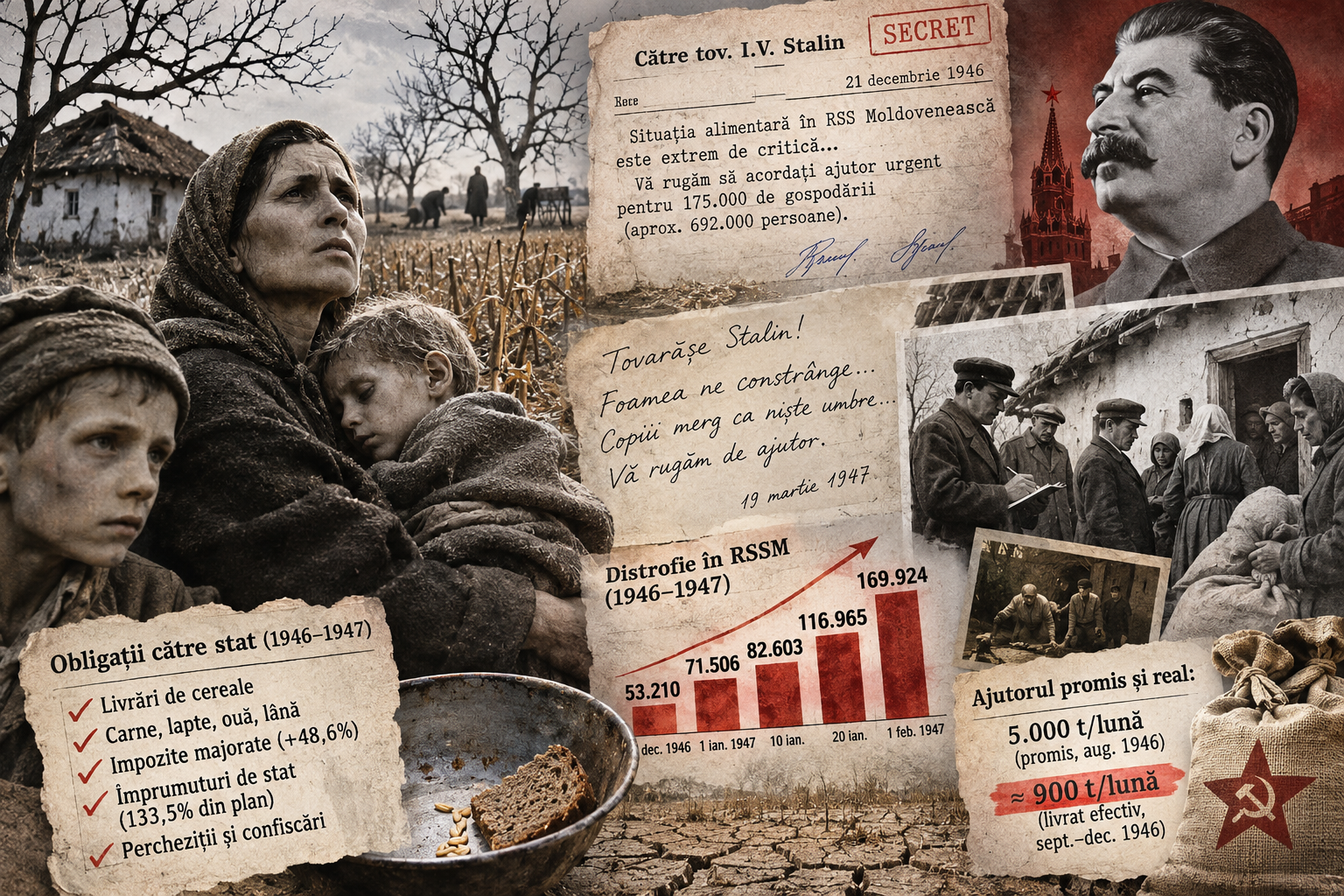
On 21 December 1946, a letter signed by F. M. Butov, Nicolae Coval, and Gherasim Rudi informed Stalin of the grave food situation in the Moldavian SSR. It referred to the destruction or severe damage of the harvest on approximately 320,000 hectares and requested assistance for 175,000 households, comprising approximately 692,000 people.[8]
This document indicates that, by the end of 1946 at the latest, the seriousness of the situation was known at the central level.
Moscow had intervened earlier as well. In August 1946, a food loan of 24,000 tons of grain had been approved and the delivery target had been reduced.[9]
The existence of these measures cannot be used either to prove the absence of responsibility or to establish it automatically. It does show, however, that the central authorities had recognised the existence of a crisis.
More significant is the relationship between the relief envisaged and the relief actually delivered. According to the documentation analysed in my monograph RSSM în anii foametei staliniste (1946–1947): între teroarea politică și drama supraviețuirii [The Moldavian SSR during the Stalinist Famine (1946–1947): Between Political Terror and the Drama of Survival], the decision of 19 August 1946 provided for the delivery to the Moldavian SSR of 5,000 tons of grain per month for consumption. For the period September–December 1946, the average quantity actually delivered appears to have been approximately 900 tons per month.[10]
The discrepancy between promised and actually delivered relief should be treated as a concrete documentary problem rather than as a rhetorical argument.
The relevant question is:
what resources could have been mobilised, what resources were in fact mobilised, and how quickly did they reach the population?
The research of Filip Slaveski, Yurii Shapoval, and Igor Cașu on centre–periphery relations provides additional evidence concerning Moscow’s involvement. The authors examine Alexei Kosygin’s mission to the Moldavian SSR in February 1947 and its connection with the adoption of new relief measures.[11]
These findings support the conclusion that the situation in the Moldavian SSR was known and discussed at the level of the Soviet leadership.
The leadership of the Moldavian SSR: between implementing directives and room for action
The role of the republican leadership requires separate analysis.
It would be too simplistic to attribute to it the same degree of responsibility as to the Soviet centre without examining its actual degree of autonomy.
The Moldavian SSR operated within a centralised state. Its leadership could not independently determine the main economic policies of the USSR, nor did it freely control Union resources.
At the same time, the republican administration organised the implementation of directives, controlled the district apparatus, centralised information, and participated in the management of relief.
Medical records demonstrate that the situation was known.
On 1 December 1946, 53,210 cases of dystrophy had been registered, including 16,133 children under the age of four. By 1 January 1947, the number had reached 71,506; by 10 January, 82,603; by 20 January, 116,965; and by 1 February, 169,924.[12]
These figures indicate that the administrative apparatus of the Moldavian SSR was not without information about the scale of the crisis.
This leads to a more precise question than the simple statement that “the republican administration was responsible”:
what real possibilities did the leadership of the Moldavian SSR have to alter policy, and what did it do within those limits?
The documents show that the republican authorities requested additional assistance from Moscow.
At the same time, they continued to administer the mechanisms of procurement and taxation.
This dual role must be examined without turning the leadership of the Moldavian SSR either into a fully autonomous actor or into a mere mechanism entirely devoid of decision-making capacity.
Executor or victim of the system?
At the local level, the problem becomes even more complex.
In the villages of the Bessarabian part of the republic, policy was implemented by agricultural plenipotentiaries, members of soviets, Komsomol members, teachers, and other individuals mobilised into the administrative apparatus. At certain moments, the network of control reached approximately one activist for every seven households.[13]
Sources describe searches for grain in attics, walls, and floors, as well as the seizure of property from households unable to meet their obligations.[14]
These practices, however, should not automatically be transformed into a collective accusation against all those involved.
In my monograph RSSM în anii foametei staliniste (1946–1947): între teroarea politică și drama supraviețuirii [The Moldavian SSR during the Stalinist Famine (1946–1947): Between Political Terror and the Drama of Survival], I showed that, beginning in November 1946, the Soviet authorities intensified pressure on local leaders who failed to fulfil grain procurement targets. The documents contain accusations of “sabotage” and complicity with “enemies of the people.”[15]
This situation is essential for assessing the behaviour of local administrators.
A local official who knew that failure to carry out a directive could turn him or her into a political suspect was not acting under the same conditions of freedom as the leadership that had formulated the directive.
This makes it necessary to distinguish between at least three situations:
implementation under coercion; implementation with a certain margin of choice; and use of the system for abuse or personal advantage.
These situations should not be treated as equivalent.
At the local level, responsibility should be established only through the examination of concrete behaviour: what the person concerned could realistically refuse to do, what risks refusal entailed, whether the order was applied minimally or exceeded, whether individuals were protected, whether denunciations were made, whether material advantage was obtained, or whether the system was used in personal conflicts.
Under a repressive regime, an administrative position does not in itself prove freedom of decision.
This does not absolve those whose abuses can be demonstrated. But neither does it permit collective blame to be attributed to all those incorporated into the local apparatus.
Letters to Stalin and perceptions of centre–periphery relations
My volume Scrisori către Stalin sau spovedaniile celor ocupați (1947–1953) [Letters to Stalin, or the Confessions of the Occupied (1947–1953)] offers an important perspective on the way people in the Moldavian SSR understood—or were compelled to formulate—the relationship between central power and local authority.
On 19 March 1947, the teachers Ignatieva, Pronin, and Lebedeva from Soroca wrote to Stalin that their bread lasted for only half the month, that they had sold their belongings, and that people with children “walk like shadows.” The reason for their appeal was summarised in the phrase: “hunger compels us.”[16]
Yet they did not accuse Stalin.
They addressed him “as a father” and attributed injustice to local officials.
This language cannot be read as evidence that the authors genuinely regarded the centre as innocent. The petition was written within a political system in which a direct accusation against the supreme leader was practically impossible.
Only two days later, the administration of Soroca County reported that the problems described had allegedly not been confirmed.[17]
On 3 June 1947, Dora Belaia of Chișinău wrote to Stalin that “our working people are dying of hunger.” The subsequent administrative response focused on the condition and credibility of the author rather than on the collective situation she had described.[18]
These documents do not by themselves prove Stalin’s personal responsibility for every situation described.
They do, however, demonstrate that information concerning famine and failures in distribution circulated through the administrative apparatus and reached central structures.
This distinction is important.
Relief and the limits of intervention
The Soviet state did provide food relief.
This reality must be incorporated into the analysis rather than ignored.
By January 1947, approximately 500 food canteens were in operation. Access, however, was limited, and lists of beneficiaries were compiled by local authorities.[19]
In my monograph RSSM în anii foametei staliniste (1946–1947): între teroarea politică și drama supraviețuirii [The Moldavian SSR during the Stalinist Famine (1946–1947): Between Political Terror and the Drama of Survival], I also examined the gap between the number of people affected and the capacity of the relief system. In February 1947, approximately 240,000 people were suffering from alimentary dystrophy, while approximately 100,000 were receiving assistance through the canteen system.[20]
Relief was not distributed uniformly. In the Bessarabian part of the Moldavian SSR, food points served approximately half of those officially registered as needing assistance, whereas the proportion was higher in the districts on the left bank of the Dniester.[21]
This difference is also important terminologically: when comparing the two areas within the republic, the more precise formulation is the Bessarabian part of the Moldavian SSR in relation to the districts on the left bank of the Dniester.
These data do not justify a simple conclusion such as “the state helped” or “the state did not help.”
They require an examination of the relationship between the scale of the crisis and the scale of intervention.
Relief should therefore be assessed through concrete questions:
when was it authorised, how much was planned, how much was actually delivered, and how many people benefited?
Not three equal levels of guilt, but different levels of power
The problem of responsibility cannot be adequately represented through a scheme in which Moscow, Chișinău, and the village appear as three comparable levels.
They did not possess equal power.
The Soviet centre had the greatest capacity to define economic objectives, modify plans, and redistribute resources.
The leadership of the Moldavian SSR had a more limited room for manoeuvre, but it participated in administering and implementing policy.
At the local level, people could simultaneously be executors of the system, victims of political pressure, and, in certain documented cases, perpetrators of abuses of their own.
For this reason, rather than constructing an abstract hierarchy of “guilt,” it is more useful to examine the hierarchy of power and of actual decision-making capacity.
The greater an actor’s ability to formulate, modify, or halt policy, the more direct the question of political responsibility becomes.
The more that actor’s freedom of action was constrained by the threat of repression, the more carefully and individually responsibility must be assessed.
This distinction is especially important in the case of Bessarabia, where local society was undergoing an accelerated process of Sovietisation, while the institutions of the Moldavian SSR functioned as the administrative mechanism through which Soviet policy was implemented.
Conclusion
The drought of 1946 was real.
The destruction caused by the war increased the region’s economic vulnerability.
But neither drought nor war alone explains the operation of the procurement system, the continuation of fiscal obligations, the selective and delayed character of some relief measures, or the pressure placed upon the local administrative apparatus.
The documents examined indicate that the Soviet state possessed the greatest decision-making capacity over resources, procurements, and emergency interventions.
Under these circumstances, political responsibility should be analysed primarily in relation to the Soviet centre, because it controlled the general framework within which the crisis unfolded.
The responsibility of the apparatus of the Moldavian SSR should be evaluated according to its actual degree of autonomy and the specific measures it adopted.
At the district and village levels, however, the attribution of collective responsibility is methodologically unjustified. Here, individual analysis is required, taking into account behaviour, coercion, and real possibilities of choice.
Under a regime of terror, the fact that a person participates in implementing a policy does not automatically demonstrate that he or she is also the author of that policy.
The question that best organises the analysis is therefore not:
“Who participated in implementing the policy?”
but rather:
“Who had the actual power to formulate, modify, or halt the policy, and what did they do with that power once its consequences had become known?”
From this perspective, the documents point primarily toward the centre of the Soviet state, without eliminating the need for separate research into institutional and individual responsibilities at lower levels.
Notes
[1] Mariana S. Țăranu, RSSM în anii foametei staliniste (1946–1947): între teroarea politică și drama supraviețuirii [The Moldavian SSR during the Stalinist Famine (1946–1947): Between Political Terror and the Drama of Survival], Chișinău, Lexon-Prim, 2026, pp. 8–9; Constantin A. Dissescu, “Un fenomen meteorologic neobișnuit – Seceta anului 1946” [“An Unusual Meteorological Phenomenon—the Drought of 1946”], in Analele Academiei Române. Memoriile Secțiunii Științifice [Annals of the Romanian Academy. Memoirs of the Scientific Section], series III, vol. XXIII, 1947–1948, București, 1948, pp. 123–135.
[2] Stephen G. Wheatcroft, “The Soviet Famine of 1946–1947, the Weather and Human Agency in Historical Perspective”, Europe-Asia Studies, vol. 64, no. 6, 2012, pp. 987–1005, DOI: 10.1080/09668136.2012.691725.
[3] Michael Ellman, “The 1947 Soviet Famine and the Entitlement Approach to Famines”, Cambridge Journal of Economics, vol. 24, no. 5, 2000, pp. 603–630, DOI: 10.1093/cje/24.5.603.
[4] Mariana S. Țăranu, RSSM în anii foametei staliniste… [The Moldavian SSR during the Stalinist Famine…], p. 49; Mihai Gribincea, Basarabia în primii ani de ocupație sovietică (1944–1950) [Bessarabia in the First Years of Soviet Occupation (1944–1950)], Cluj-Napoca, Dacia, 1995, p. 74.
[5] Mariana S. Țăranu, RSSM în anii foametei staliniste… [The Moldavian SSR during the Stalinist Famine…], p. 49.
[6] Ibidem, p. 50; Mihai Gribincea, Op. cit., p. 74.
[7] Mariana S. Țăranu, RSSM în anii foametei staliniste… [The Moldavian SSR during the Stalinist Famine…], pp. 50–51; AOSPRM, F. 115, inv. 1, dos. 71, f. 77 verso.
[8] Ibidem, p. 98. The letter of 21 December 1946 was signed by F. M. Butov, Nicolae Coval, and Gherasim Rudi and addressed to I. V. Stalin.
[9] Ibidem, p. 98; Igor Cașu, Dușmanul de clasă. Represiuni politice, violență și rezistență în R(A)SSM, 1924–1956 [The Class Enemy: Political Repression, Violence, and Resistance in the M(A)SSR, 1924–1956], Chișinău, Cartier, 2013, p. 211, apud Țăranu.
[10] Mariana S. Țăranu, RSSM în anii foametei staliniste… [The Moldavian SSR during the Stalinist Famine…], p. 99; Igor Cașu, Op. cit., pp. 212–213.
[11] Ibidem, p. 99; Valeriu Pasat, RSS Moldovenească în epoca stalinistă (1940–1953) [The Moldavian SSR in the Stalinist Era (1940–1953)], Chișinău, Cartier, 2011, p. 256; Filip Slaveski, Yurii Shapoval, Igor Cașu, “Centre-Periphery Relations in the Soviet Post-War Famine of 1946–47”, in Ingrid de Zwarte and Miguel Ángel del Arco Blanco (eds.), The Politics of Famine in European History and Memory, New York, Routledge, 2025, pp. 71–88.
[12] Mariana S. Țăranu, RSSM în anii foametei staliniste… [The Moldavian SSR during the Stalinist Famine…], p. 104; Foametea din Moldova sovietică (1946–1947). Culegere de documente [The Famine in Soviet Moldova (1946–1947): A Collection of Documents], coord. Anatol Țăranu, Chișinău, Litera, 2017, pp. 409, 451, 530.
[13] Mariana S. Țăranu, RSSM în anii foametei staliniste… [The Moldavian SSR during the Stalinist Famine…], pp. 57–58, 132; AOSPRM, F. 62, inv. 1, dos. 71, f. 96; AOSPRM, F. 66, inv. 1, dos. 65, ff. 8, 12, 14.
[14] Ibidem, pp. 57–58, 132–133.
[15] Ibidem, p. 104; see also Foametea din Moldova sovietică (1946–1947). Culegere de documente [The Famine in Soviet Moldova (1946–1947): A Collection of Documents], p. 216.
[16] Mariana S. Țăranu (comp.), Scrisori către Stalin sau spovedaniile celor ocupați (1947–1953) [Letters to Stalin, or the Confessions of the Occupied (1947–1953)], Chișinău, Pontos, 2014, pp. 57–58, letter no. 1; ANRM, F. 2848, inv. 7, dos. 1, f. 488; Mariana S. Țăranu (ed.), Un genocid nerecunoscut [An Unrecognized Genocide], București, Vremea, 2020, pp. 32–33.
[17] Mariana S. Țăranu (ed.), Un genocid nerecunoscut [An Unrecognized Genocide], p. 33, note 19; ANRM, F. 2848, inv. 7, dos. 1, f. 487a.
[18] Mariana S. Țăranu (comp.), Scrisori către Stalin… [Letters to Stalin…], p. 58, letter no. 2; Mariana S. Țăranu (ed.), Un genocid nerecunoscut [An Unrecognized Genocide], p. 34; ANRM, F. 2848, inv. 7, dos. 3, ff. 445–446 verso.
[19] Mariana S. Țăranu (ed.), Un genocid nerecunoscut [An Unrecognized Genocide], pp. 31–32, document no. 1; AOSPRM, F. 36, inv. 1, dos. 44, f. 13; Mariana S. Țăranu, RSSM în anii foametei staliniste… [The Moldavian SSR during the Stalinist Famine…], pp. 99–100.
[20] Mariana S. Țăranu, RSSM în anii foametei staliniste… [The Moldavian SSR during the Stalinist Famine…], p. 101; Lidia Pădureac, “Comunism prin înfometare: bolnavii «D» în Basarabia sovietizată” [“Communism through Starvation: ‘D’ Patients in Sovietized Bessarabia”], in Cristina Preutu and Anatol Petrencu (eds.), Fațete ale comunismului în România și în R(A)SS Moldovenească: politică, societate și economie [Facets of Communism in Romania and the M(A)SSR: Politics, Society, and Economy], Iași, Editura Universității “Alexandru Ioan Cuza”, p. 141.
[21] Mariana S. Țăranu, RSSM în anii foametei staliniste… [The Moldavian SSR during the Stalinist Famine…], p. 101; Lidia Pădureac, Op. cit., pp. 141–142.